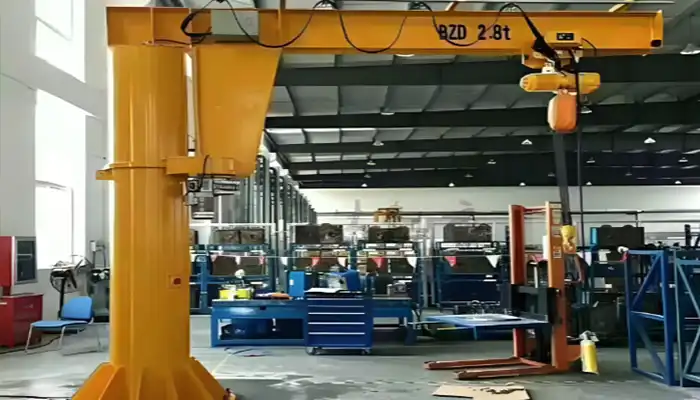
Jib Crane Foundation Design: Key Steps to Prevent Failure
menu_open
Content Quick Link
Most Important Takeaway
Most jib crane failures are not caused by the crane itself—but by poor foundation design, incorrect anchor bolt installation, or insufficient concrete curing. A properly engineered base determines whether the crane operates safely or overturns under load.
- Foundation quality directly controls jib crane stability and safety
- Incorrect anchor bolt positioning is the most common installation error
- Double-layer reinforced steel is required to resist lifting torque
- Concrete grade and vibration directly affect structural integrity
- Curing time is critical before load testing or operation
FAQ: Jib Crane Foundation and Installation
What are the structural requirements for a jib crane foundation?
A jib crane foundation must be designed to carry both vertical load and overturning moment.
In practice, the base size is usually not small. The pit is often made at least 3 times the column diameter to spread load into soil.
Inside, the foundation needs:
- stable soil compaction
- proper depth for load transfer
- rigid base to prevent settlement
If the soil is weak or uneven, the crane will slowly tilt during use. This is common in workshop installations where ground preparation is ignored.
Why do jib cranes overturn even when the crane structure is strong?
Most overturning cases are not caused by the crane body.
The main reasons are:
- undersized foundation
- poor soil compaction
- anchor bolts shifting during concrete pouring
- incorrect reinforcement layout
- early loading before curing is complete
A jib crane creates a large bending force when the arm is fully extended. If the base cannot resist this moment, the whole unit starts to loosen or tilt.
So in real projects, the foundation is always the first point to check.
How should anchor bolts be installed and protected correctly?
Anchor bolts must follow the foundation drawing exactly. No free adjustment on site.
Key points:
- fix bolts using a steel template before pouring
- weld or lock them so they do not move
- check spacing and vertical alignment twice
- protect threads with tape before concrete work
If concrete covers the threads, installation becomes difficult or sometimes impossible without rework.
Even small misalignment can cause the crane column to lean after installation.
What reinforcement method is required for crane column foundations?
The foundation should use double-layer reinforcement in both directions.
Steel bars must be arranged horizontally and vertically in a cross pattern.
This structure helps resist:
- lifting tension
- rotation force from slewing motion
- repeated dynamic load during operation
Single-layer reinforcement is not stable enough for long-term industrial use, especially in frequent lifting environments like workshops or assembly lines.
What concrete grade is suitable for jib crane installation?
For standard jib crane foundations, C30 concrete or higher is commonly used.
Lower grades are not recommended because the base must resist:
- compression from column load
- bending force from crane rotation
- long-term fatigue from repeated lifting
During pouring, concrete must be vibrated properly. Without vibration, air pockets remain inside and reduce strength.
Surface leveling is also important. An uneven base will directly affect crane vertical alignment.
How long should a jib crane foundation be cured before use?
The foundation should be cured for at least 15–20 days before installing or loading the crane.
During curing, concrete gains its designed strength.
If installation is done too early:
- anchor bolts may loosen
- cracks may form in the base
- the crane may shift under load
In many field cases, early installation is the root cause of foundation failure. Waiting for full curing time is necessary for safe operation.
Jib Crane Foundation Requirements
A flloor mounted jib crane looks simple on top. Column, arm, hoist. That’s it.
But the real problem is always at the bottom. The foundation.
If the base is wrong, the crane will tilt or loosen over time. Sometimes it fails under load. Not because the crane is weak, but because the ground work is not right.
Foundation Excavation: Size Matters More Than People Think
Why pit size is critical in jib crane foundation design
First step is digging the pit. Don't make it small to save concrete. That's where most problems start.
A common rule used on site:
The pit should be at least 3 times the column base diameter.
Deeper and wider excavation improves load transfer by spreading forces into a larger soil area, reducing local stress concentration.
Soil condition and excavation depth requirements
If the soil is soft, the foundation requires increased depth and improved compaction. There is no shortcut here.
- Soft soil → deeper excavation required
- Weak subgrade → higher risk of settlement
- Uneven soil → potential tilting under load
Proper ground preparation is essential before any reinforcement or concrete work begins.
Why small foundations fail in real workshop conditions
On many workshop projects, a common issue appears repeatedly: small foundation combined with a large crane arm and long working radius.
This combination increases overturning force significantly during operation.
- Long jib arm increases bending moment
- Small base reduces soil resistance area
- Frequent lifting amplifies cumulative stress
In practice, foundation size directly determines long-term stability, not just initial installation success.
Reinforcement Steel: It Must Be Double Layer
Why double-layer reinforcement is required in jib crane foundations
Inside the foundation, steel cage is not optional.
Use double-layer reinforcement in both horizontal and vertical directions, forming a crossed grid system.
This configuration improves structural rigidity and load distribution under crane operating conditions.
How jib crane forces act on the foundation
A jib crane does not only apply vertical load. During operation, the foundation is subjected to multiple force types simultaneously.
- Pulling force during lifting operations
- Twisting force during slewing (rotation)
- Uneven load distribution when the jib arm is fully extended
These combined effects create complex stress patterns inside the concrete base.
Why single-layer reinforcement is not suitable for crane loads
Single-layer reinforcement often cannot provide sufficient resistance under repeated dynamic and rotational loading.
In real operation, failure does not appear immediately. The structure may look stable at first, but long-term stress leads to:
- Gradual crack formation in concrete
- Reduced stiffness under cyclic loading
- Loss of structural integrity over time
For this reason, double-layer reinforcement is the standard requirement for industrial jib crane foundations.
Anchor Bolts: Most Common Installation Mistake
Why anchor bolts are critical in jib crane installation
Anchor bolts decide everything in a wall-mounted or column-mounted jib crane system.
If anchor bolts move during concrete pouring, the crane column will not remain vertical after installation.
How to properly fix anchor bolts before concrete pouring
Anchor bolts must be fixed securely before concrete work begins.
- Use a positioning template to lock bolt spacing
- Weld bolts or mechanically secure them if required
- Ensure no movement during concrete pouring
Loose anchor bolts during installation are a major cause of misalignment in crane columns.
Why protecting bolt threads is necessary
Before pouring concrete, bolt threads must be wrapped with protective tape.
This prevents concrete from covering the threads, which can cause serious installation delays or rework.
Although simple, this step is often skipped in practice, leading to unnecessary site problems later.
Why alignment must be checked more than once
Anchor bolt alignment must be checked at least twice before pouring concrete.
Even small deviations can lead to significant column tilt at the top after installation.
In practice, minor installation errors at the base become amplified at crane height.
Concrete Pouring: Use Proper Grade and Vibration
What concrete grade is required for jib crane foundations
For jib crane foundations, C30 concrete or above is recommended.
Lower-grade concrete is not suitable for long-term industrial use because it cannot reliably resist repeated lifting loads, bending moments, and dynamic forces.
Why concrete vibration is essential during pouring
Concrete must be properly vibrated during pouring.
This is a critical step in foundation quality control.
If vibration is skipped, several structural issues may occur:
- Air pockets remain inside the concrete mass
- Local weak zones develop within the foundation
- Load transfer becomes uneven under crane operation
Proper vibration ensures dense, uniform concrete with stable load-bearing performance.
Why surface leveling is important after pouring
After pouring, the foundation surface must be carefully leveled.
If the surface is uneven, even a small slope can cause the crane column to lean after installation.
This affects vertical alignment and long-term operational stability.
In practice, precise leveling at this stage directly determines installation accuracy later.
Curing Time: Don't Rush Installation
Why curing time is critical for jib crane foundations
This is where many projects fail.
After concrete pouring, the foundation must be allowed to cure properly before any installation or loading begins.
Minimum curing time is 15–20 days.
Some sites attempt installation after 7–10 days, but this is too early for safe industrial use.
What happens if installation is done too early
During curing, concrete is still gaining strength and structural stability.
If installation is performed too early, several failures may occur:
- Anchor bolts may loosen under load
- Foundation base may develop cracks
- The crane structure may shift during operation
These issues often appear during early lifting cycles when stress is first applied.
Real-world failure cases linked to early installation
In field practice, severe foundation failures have been observed where installation was rushed before full curing.
In some cases, the entire base structure was pulled or damaged during lifting operations.
Root cause analysis almost always traces back to insufficient curing time.
There is no shortcut here. Proper waiting time is part of structural safety.
Conclusion
A jib crane is only as stable as its foundation.
If excavation is correct, steel is double-layered, anchor bolts are fixed properly, concrete is well compacted, and curing time is respected, the crane will work safely for a long time.
Most problems are not from the crane itself. They come from the base.
That’s the part that decides everything.

Article by Bella ,who has been in the hoist and crane field since 2016. Bella provides overhead crane & gantry crane consultation services for clients who need a customized overhead travelling crane solution.Contact her to get free consultation.